
24/04/2026

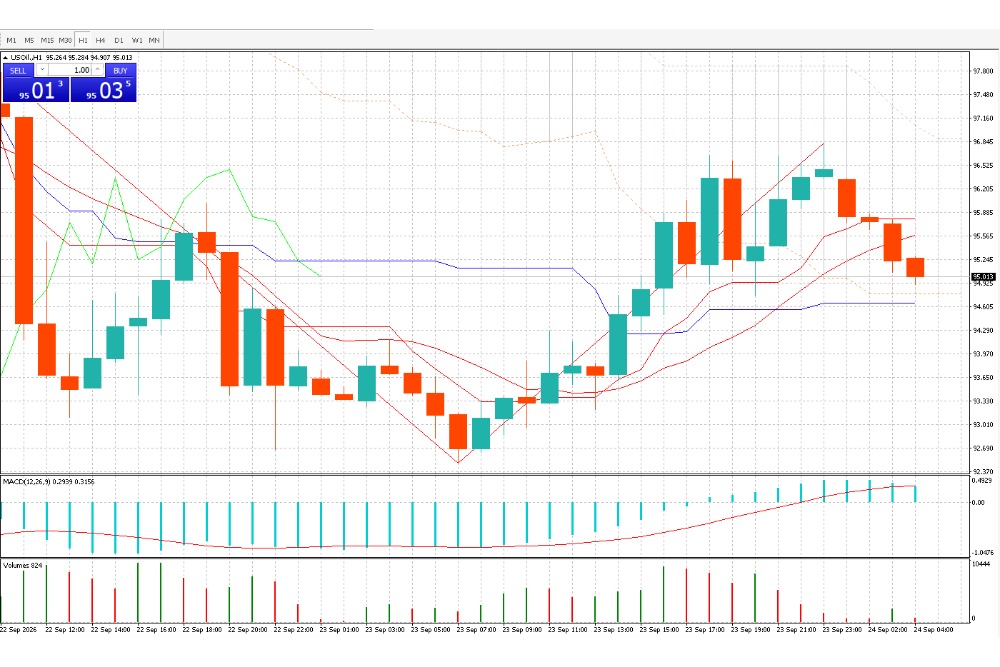
Currently, there has been little progress in negotiations between the United States and Iran to ease tensions, and the Strait of Hormuz remains effectively closed. Affected by this, international crude oil prices have risen for the fifth consecutive trading day. Brent crude, the global benchmark for crude oil, rose 1.5% to exceed $106.50 per barrel; so far this year, oil prices have soared by 75%, with most of the gains occurring after the outbreak of the war. The closure of the Strait of Hormuz has directly blocked the transportation channel of Middle Eastern oil to other parts of the world. The strait handles more than a quarter of the world’s seaborne oil shipments and about one-fifth of liquefied natural gas (LNG) transportation, and its disruption has directly impacted global energy supply.
The escalation of geopolitical risks has also triggered a chain reaction in global financial markets. Driven by concerns about the escalation of the Middle East conflict, the Bloomberg Dollar Index is on track to record its first weekly gain in four weeks; at the same time, inflation concerns triggered by rising oil prices continue to fester, and U.S. Treasury bond prices remain in a downward trend. Global stock markets have shown a mixed trend: Asian stocks fell slightly by 0.2%, with the MSCI Asia-Pacific Index opening down 0.2%, although Japan’s Nikkei 225 Index bucked the trend and rose slightly by 0.6%; thanks to Intel’s strong earnings forecast, Nasdaq 100 Index futures rose 0.7% in early trading on Friday.
Although the risk premium in financial markets has declined in recent weeks, investors remain cautious ahead of the weekend. The key to market trends depends on whether the tense situation in Iran will escalate further or shift towards a diplomatic solution. Traders are closely monitoring various signals released by Washington and Tehran, as well as shipping dynamics in the Strait of Hormuz, to capture clues about energy supply risks. It is generally believed in the industry that any disruption to the strait’s passage could lead to persistently high oil prices and put pressure on global economic growth. Giovanni Staunovo, an analyst at UBS Group in Zurich, also said: “As long as oil flows through the strait remain restricted, the market remains tight, and oil inventories continue to decline, oil prices will be supported.”
Behind the deadlock in U.S.-Iran negotiations is closely related to the relevant statements of U.S. President Donald Trump. According to several officials familiar with the diplomatic efforts of both sides, Trump’s threatening remarks and reckless social media posts have seriously hindered Iran’s willingness to agree to more face-to-face peace negotiations. Iranian Deputy Foreign Minister Sayyid Abbas Araghchi once commented that Trump “talks too much,” and his contradictory statements have made Iran more vigilant and strengthened its negotiating position—only if the agreement includes a clear and irreversible performance binding mechanism to ensure Trump abides by all commitments will Iran be willing to sign the agreement.
Previously, Trump had ordered the U.S. Navy to fire on any ships laying mines in the Strait of Hormuz, while claiming that Tehran hoped to reach an agreement and that negotiations were underway; at the same time, U.S. troops boarded a supertanker carrying Iranian oil in the Indian Ocean, and the U.S. Navy further strengthened its blockade on Iranian shipping. In response, Tehran has continued to effectively block the Strait of Hormuz, preventing hundreds of millions of barrels of oil, fuel and other commercial ships from passing through. Traffic in the strait came to a standstill on Thursday, with only one bulk carrier moving and no ships entering. However, later on Thursday, Trump announced that Israel and Lebanon would extend the ceasefire agreement by three weeks, a move that created space for reaching a long-term agreement and cleared some obstacles to ending the U.S.-Iran war.
The performance of other market sectors is also worthy of attention. In the U.S. stock market, although Wall Street stock indexes fell slightly on Thursday, positive news from Intel boosted market sentiment. The chipmaker reported first-quarter 2026 revenue of $13.6 billion, a year-on-year increase of 7%, and its second-quarter revenue guidance also exceeded expectations. Affected by this, its after-hours stock price soared nearly 20%, hitting a record high, and Nasdaq 100 Index futures also strengthened in early trading on Friday. At the same time, semiconductor stocks performed exceptionally strongly, rising for the 17th consecutive trading day, which is closely related to the increased demand for CPUs driven by the artificial intelligence wave. Intel’s data center and artificial intelligence product revenue increased by 22% year-on-year, becoming the company’s fastest-growing business segment.
In the foreign exchange market, the yen traded relatively steadily during the Asian session. Previously, the yen had weakened against the U.S. dollar for four consecutive trading days, hovering around 159 yen per U.S. dollar, close to the “red line” for the Japanese government to intervene in the foreign exchange market. Japanese Finance Minister Sanae Takaichi warned that due to the weakness of the yen caused by speculative activities, Tokyo is maintaining a high degree of vigilance, and relevant officials have established round-the-clock close contact with their U.S. counterparts, ready to respond to abnormal exchange rate fluctuations at any time.
[Disclaimer] Forex trading involves risk; please invest with caution. This content is for informational purposes and objective analysis only, and does not constitute any investment advice, basis for buying/selling, or guarantee of returns. Investors should make independent decisions based on their own financial situation and risk tolerance, and bear their own investment risks.
Related Posts

23/09/2026
23/09/2026