23/04/2026

- Market Recap
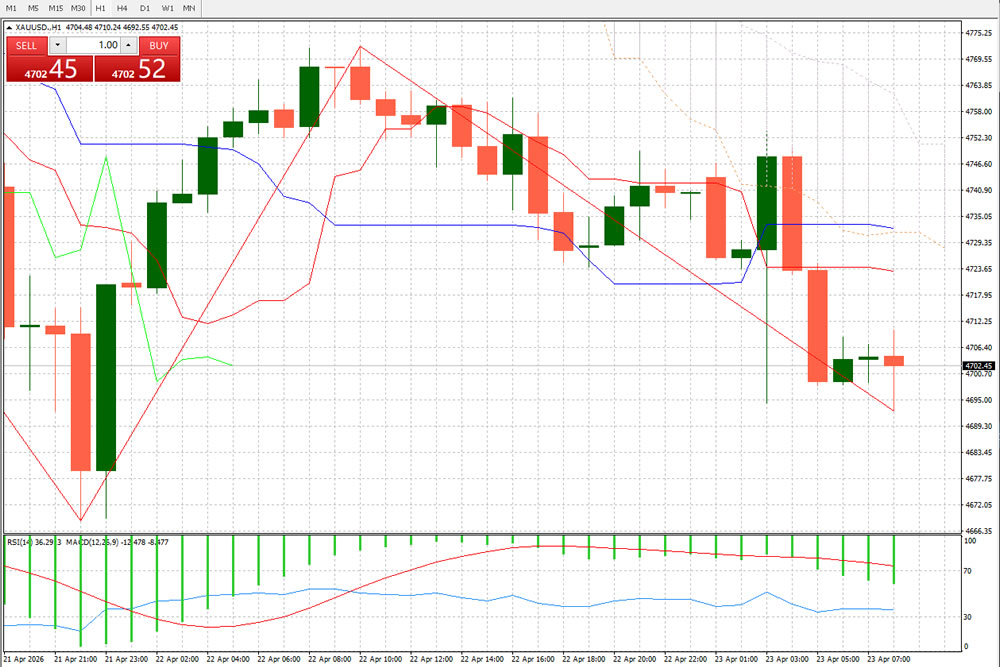
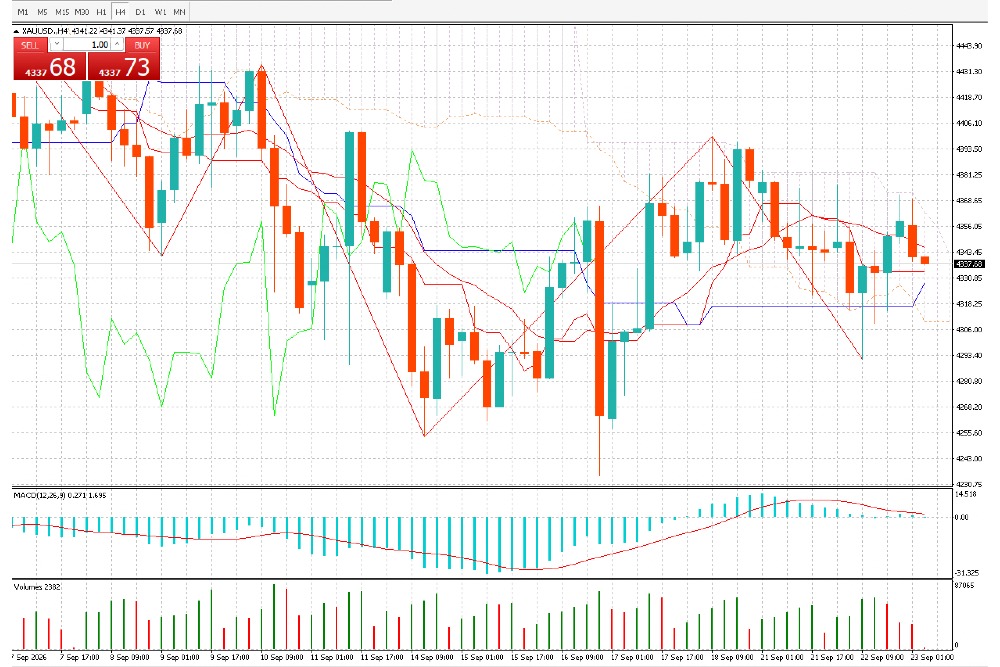
Spot gold (XAU/USD) traded in a range-bound pattern around the key $4,700 level during the Asian session on April 23, hitting an intraday low of $4,692.2/oz and currently quoting at $4,706.26/oz, down 0.44% on the day.
From the 1-hour candlestick chart, gold has formed a clear downward trend after hitting a peak of $4,832/oz on April 21. A series of candlesticks have broken below short-term moving average support, with the Bollinger Bands opening downward. Price is hovering near the lower band of the channel, dominated by bearish sentiment. The $4,700 psychological level acts as the critical line of contention between bulls and bears. The $4,680-$4,690 zone forms a strong short-term support, while the $4,730-$4,750 zone serves as the immediate resistance for any technical rebound.
- Core Driving Factors
(1) Macroeconomic Pressure: Dovish Fed Expectations Fade, Strong USD Weighs Heavily
Better-than-expected U.S. economic data, including a 1.7% MoM surge in core retail sales (vs. 1.4% forecast) and persistently high crude oil prices (Brent above $95/bbl), have significantly cooled market expectations for Fed rate cuts. The probability of a rate cut in 2026 has plummeted from 46% to 20%, with the first cut now fully priced in for July 2027. The 10-year U.S. Treasury yield remains anchored at 4.25%-4.30%, increasing the opportunity cost of holding non-interest-bearing gold. Meanwhile, the U.S. Dollar Index (DXY) hit a 7-day high of 98.57, making gold more expensive for global investors and eroding its appeal.
(2) Fund Flow: Institutional Outflows Persist, Bullish Sentiment Wanes
Global gold ETFs, led by the SPDR Gold Trust, have seen consecutive outflows for three consecutive days. As of April 22, holdings stood at 1,050.907 tons, a sign of institutional caution. Additionally, massive profit-taking occurred after gold rallied from $3,200 to a record high of $4,888/oz, with heavy selling pressure emerging above the $4,800 level, exacerbating short-term volatility.
(3) Risk Sentiment: Geopolitical Risk Premium Fades Marginally
Rising hopes for a resumption of peace talks between the U.S. and Iran have eased geopolitical tensions in the Middle East, reducing demand for gold as a safe-haven asset. Funds have rotated into riskier assets such as U.S. equities (the Dow and Nasdaq both gained over 0.6% on April 22). However, unresolved shipping risks in the Strait of Hormuz and elevated crude oil prices provide implicit support for gold, limiting further downside.
- Technical Levels & Trend Analysis
Support Levels: Focus on $4,700 (psychological level + lower Bollinger Band) and the $4,680-$4,690 zone (previous swing lows). A break below this zone would trigger a further decline toward $4,650.
Resistance Levels: Immediate resistance at $4,730-$4,750 (short-term moving average resistance); next resistance at $4,780-$4,800 (yesterday’s rebound high). A breakout above this range would ease bearish pressure.
Indicator Signals: The 1-hour RSI stands at 36.29, in a neutral-to-weak range without oversold rebound signals. The MACD green column is shrinking, indicating easing bearish momentum but no confirmed bullish crossover, casting doubt on the sustainability of any short-term rebound.
- Outlook & Trading Strategy
Short-Term (1-3 Trading Days)
Gold is likely to trade in a range of $4,680-$4,780. Key U.S. data releases—Q1 GDP and core PCE on April 24-25—will be the catalysts for a breakout. Stronger-than-expected data will reinforce the Fed’s hawkish stance, potentially pushing gold below $4,700 to $4,650. Weaker data will reignite rate-cut hopes, fueling a rebound toward $4,780.
Medium-to-Long Term
The core bullish narrative remains intact: sustained central bank gold purchases globally and the de-dollarization trend. Major Wall Street institutions, including Goldman Sachs (2026 target: $5,400/oz) and JPMorgan ($6,300/oz), maintain bullish views. The current correction is a normal “washout” in the bull market, not the end of the uptrend.
Trading Recommendations
Short-Term Traders: Adopt range-bound strategies. Go long lightly around $4,700 with a stop loss at $4,680, targeting $4,750; go short lightly around $4,780 with a stop loss at $4,800, targeting $4,720. Strictly control position size.
Medium-Term Investors: Accumulate positions in batches near the $4,650-$4,700 support zone via gold ETFs or bank physical gold, ignoring short-term volatility.
Risk Warnings: Monitor unilateral volatility triggered by geopolitical escalations or hawkish Fed comments. Implement strict stop-loss measures to manage risks.
[Disclaimer] Forex trading involves risk; please invest with caution. This content is for informational purposes and objective analysis only, and does not constitute any investment advice, basis for buying/selling, or guarantee of returns. Investors should make independent decisions based on their own financial situation and risk tolerance, and bear their own investment risks.
Related Posts

23/09/2026
23/09/2026