

17/08/2026

Soft U.S. economic data has significantly cooled market expectations for a Federal Reserve rate hike next month, weighing on the U.S. dollar against most major currencies and driving gains in U.S. Treasury prices.
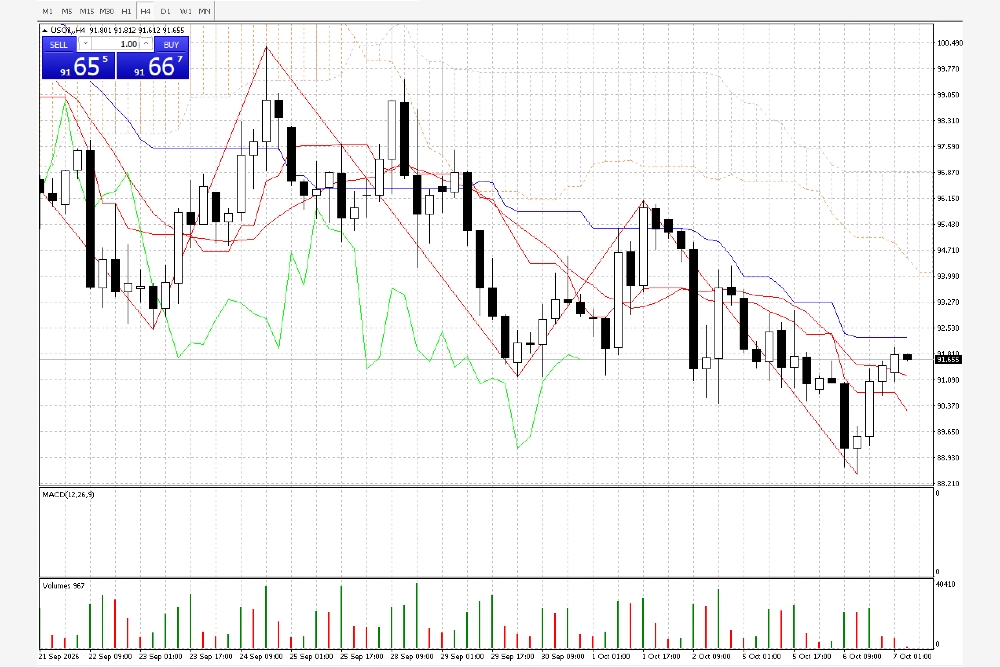
The U.S. Dollar Index edged down 0.1%, hovering near its lowest level since May. The downward pressure on the dollar was mainly driven by official data released by the U.S. government last Friday, which showed that U.S. retail sales posted their sharpest drop in more than a year in July amid shrinking consumer spending activity.
Market rate hike expectations have retreated sharply. Swap traders now price in a roughly 25% probability of a Fed rate hike next month, down from around 50% a week earlier. Amid the shifting rate outlook, the U.S. Treasury yield curve fell across all maturities. The rate-sensitive 2-year Treasury yield dropped 2 basis points to 4.15%, while the benchmark 10-year Treasury yield dipped 1 basis point to 4.68%.
Persistent soft U.S. inflation readings and weak retail sales figures have completely reversed the previous market narrative. Expectations for Fed rate hikes for the rest of the year had long underpinned U.S. dollar strength, yet market participants have now broadly scaled back bets on higher borrowing costs by the end of 2025.
Upcoming U.S. Treasury supply is in sharp market focus. The U.S. Treasury will auction 20-year bonds this week to test investor demand for long-dated U.S. debt, following a series of record-sized Treasury auctions. Last week, the U.S. government sold 30-year bonds at the highest interest rate in 25 years, signaling that investors are demanding higher yields to compensate for the country’s widening fiscal deficit.
Global commodity and equity markets traded cautiously as investors awaited fresh catalysts for directional moves. Geopolitical tensions continued to roil crude oil markets, with renewed Israeli strikes on Lebanon and potential new U.S. sanctions on Iran heightening Middle East uncertainties. Brent crude traded at $88.40 per barrel, after surging to a near $89 intraday high. Investors are closely monitoring shipping developments in the Strait of Hormuz, as changes to vessel traffic could trigger a pullback in oil prices, which rallied nearly 6% last week.
In equity markets, Asia-Pacific stocks edged up 0.1%, while South Korean financial markets were closed for a public holiday. U.S. stock futures advanced, with contracts on the S&P 500 and Nasdaq 100 indexes higher. Supported by a rebound in AI-driven trading activity, U.S. equities remained near record highs, with global market sentiment still hinging on Middle East developments for definitive trading signals.
Precious metals also moved higher, with gold prices rising 0.4% to around $4,390 per ounce.
The Japanese yen strengthened modestly against the U.S. dollar. Japan’s economic growth unexpectedly slowed in the three months ending June, dragged by sustained declines in capital expenditure, a shift that underpinned mild yen appreciation.
Market attention this week is centered on China’s key economic data due for release on Monday, including July retail sales and industrial output figures. Economists surveyed by Bloomberg expect a mild recovery in China’s consumer spending for July, alongside a slowdown in factory production activity.
[Disclaimer] Forex trading involves risk; please invest with caution. This content is for informational purposes and objective analysis only, and does not constitute any investment advice, basis for buying/selling, or guarantee of returns. Investors should make independent decisions based on their own financial situation and risk tolerance, and bear their own investment risks.
Related Posts