

13/07/2026

Following the United States’ new round of airstrikes on Iran, international oil prices posted a sharp rally while US Treasury prices fell, stoking market concerns that rising energy costs could push inflation higher and keep global interest rates elevated for an extended period. Escalating geopolitical tensions have triggered volatility across global equities, bonds, commodities, cryptocurrencies and other asset classes.
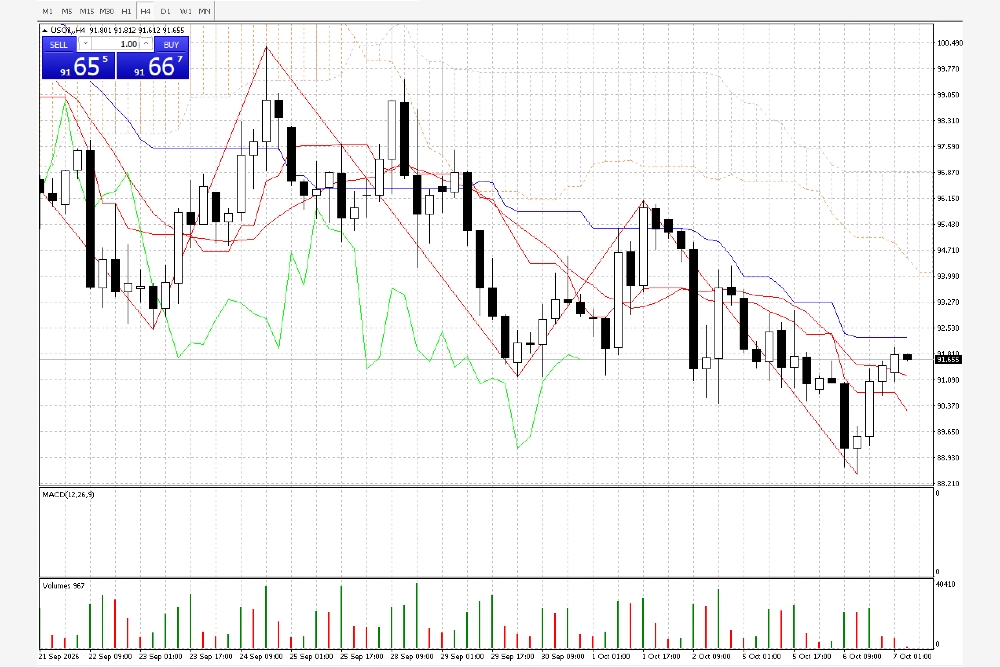
In the crude oil market, intensifying disputes over the sovereignty of the Strait of Hormuz have fueled fears of potential supply disruptions, driving a notable rise in global oil prices. Brent crude climbed more than 3% to settle at $78.50 per barrel. As a critical global energy shipping corridor, the strait’s chaotic situation has deepened market uncertainty. While Iran claimed to have closed the waterway, the US military and maritime authorities stated that vessels continue to sail through its southern shipping lanes.
Global bond markets came under broad pressure, with the entire US Treasury yield curve rising and bond prices declining. The rate-sensitive 2-year US Treasury yield increased by 3 basis points to 4.23%, hitting its highest level since February 2025. Following the US market downturn, Australian and Japanese government bonds also fell in price. Meanwhile, the US dollar strengthened across the board against all G10 currencies.
Global equities traded mixed with divergent performance. US stock index futures edged down 0.2%, while the MSCI Asia Pacific Index fluctuated narrowly with limited swings. Technology stocks remained a core market focus. South Korea’s SK Hynix tumbled 5% in Seoul, marking a notable pullback after its US-listed American Depositary Receipts (ADRs) surged 13% on their debut trading day last Friday.
The renewed geopolitical tensions in the Middle East come at a pivotal juncture for global markets, as investors brace for the kickoff of the corporate earnings season. Goldman Sachs and JPMorgan Chase are set to release their earnings reports on Tuesday. Their financial results will serve as a major benchmark, testing whether the AI-driven optimism fueling the stock market rally is backed by solid corporate earnings fundamentals.
Shoji Hirakawa, Chief Global Strategist at Tokai Tokyo Intelligence Laboratory, noted that the renewed conflict between the US and Iran could act as a negative catalyst for markets. In an environment of rising geopolitical risks, investors tend to favor sectors with robust earnings performance, which is expected to help semiconductor stocks demonstrate strong relative resilience.
Precious metals also faced downward pressure. Gold dropped 1.2% to around $4,070 per ounce, and silver fell 1.7%, as soaring oil prices and heightened inflation concerns pushed up interest rate expectations. In contrast, the cryptocurrency market staged a rebound, with Bitcoin erasing early losses and trading near $64,175.
According to US Central Command, the airstrikes launched by the US military on Sunday were designed to further weaken Iran’s capacity to target civilian vessels navigating the Strait of Hormuz. The military operation was conducted in response to Iran’s drone and missile attacks on US allies including Kuwait, Jordan and Qatar.
Beyond geopolitical conflicts, key macroeconomic data and policy events are set to dominate market sentiment this week. Oil prices previously recorded their largest weekly gain since mid-May, stirring worries that higher energy costs will further exacerbate inflationary pressures. Traders have significantly ramped up bets on further Federal Reserve monetary tightening. Swap contracts indicate market expectations for nearly 40 basis points of Fed rate hikes by December, up sharply from around 15 basis points in early June.
On the policy front, Federal Reserve Chair Kevin Walsh will attend his first congressional hearing since taking office. He has previously pledged to refine the forward guidance on interest rate outlooks, and his remarks at the hearing are likely to deliver new monetary policy signals.
For Asian markets, investors will closely monitor China’s second-quarter GDP data for fresh signs of an economic slowdown driven by weak domestic demand, as well as the policy decision from the Bank of Korea.
[Disclaimer] Forex trading involves risk; please invest with caution. This content is for informational purposes and objective analysis only, and does not constitute any investment advice, basis for buying/selling, or guarantee of returns. Investors should make independent decisions based on their own financial situation and risk tolerance, and bear their own investment risks.
Related Posts