
02/04/2026

With investors’ growing optimism that the Iran war may be coming to an end, Asian stock markets are expected to continue their recent rebound momentum, with capital flowing back into the stock market. Meanwhile, crude oil prices have fallen for the third consecutive trading day, and risk appetite in global financial markets has gradually picked up.
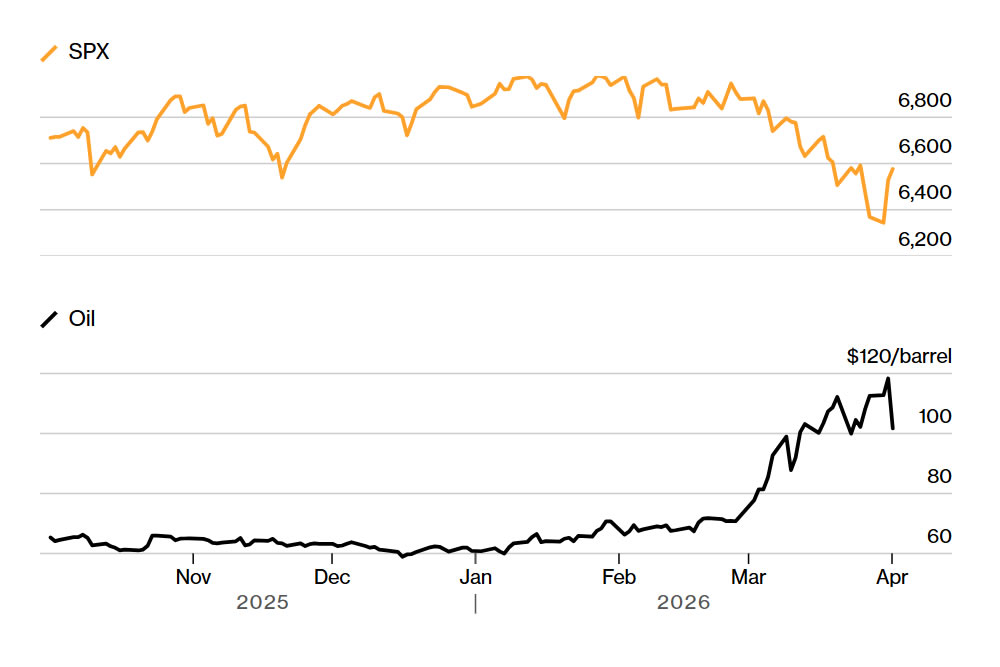
In terms of market performance, stock index futures in Japan, Hong Kong (China) and South Korea all showed an upward trend, laying a solid foundation for Asian stock markets to rise for the second consecutive trading day. U.S. stocks also performed strongly: the S&P 500 Index rose 0.7% on Wednesday, and the Nasdaq 100 Index rose 1.2%, with both benchmark indices hitting their highest levels so far this week. The market generally believes that expectations of an end to the Middle East war will effectively improve the global crude oil supply pattern, thereby injecting momentum into economic growth, which is also the core reason driving the stock index higher.
In the commodity and exchange rate markets, West Texas Intermediate (WTI) crude oil prices fell more than 1%, breaking below the $99 per barrel mark; the U.S. dollar index edged down 0.1%; and gold prices continued their upward trend, climbing to around $4,800 per ounce. The U.S. Treasury bond market fluctuated: as of Wednesday, the 10-year Treasury bond price was basically flat, the 30-year Treasury bond price rose slightly, while the 2-year Treasury bond price fell slightly due to the strong performance of U.S. labor market and retail sales data.
The current rise in market risk appetite stems mainly from eased investor concerns about the long-term continuation of the Middle East conflict. Over the past five weeks, the Iran war has caused severe volatility in global financial markets, with several major stock indices once entering a correction range. At present, market focus has shifted to U.S. President Trump’s national address—he will deliver a primetime speech at 9 p.m. Eastern Time. The market generally expects that Trump may announce a reduction in military operations against Iran, which will further ease geopolitical tensions in the Middle East.
Ulrich Hoffmann-Burchardi of UBS Global Wealth Management said: “The strong rebound in stock markets over the past 24 hours shows that a resolution to the conflict, or at least hope for a resolution, could quickly push markets higher. We still believe that global stock markets will end the year higher than their current levels.” Notably, UBS previously projected that if the Middle East conflict is resolved by early April, the S&P 500 Index is expected to rebound to 7,150 points by the end of the year, further confirming the market’s optimistic expectations after the conflict ends.
Although the Strait of Hormuz— which carries 20% of global crude oil shipments— remains largely closed, and the United Nations Conference on Trade and Development (UNCTAD) has warned that a more than 95% drop in transit volume through the strait is disrupting global energy and fertilizer flows, Trump still plans to deliver this rare primetime speech. According to a White House official, Trump is expected to praise the success of U.S. military operations in Iran in his speech and emphasize that the relevant military operations may end within two to three weeks. Trump previously stated publicly that the United States may end the war against Iran within two to three weeks, and his remarks triggered a sharp rise in stock markets on Tuesday.
Hours before Trump’s speech, the Iranian president took an unusual step by writing an open letter to the American people. In the letter, he clearly stated that Iran has no hostile relations with the United States, and all actions of Iran are legitimate self-defense. He also warned that “continuing down the path of confrontation is more costly and futile than ever before,” and pointed out that attacks on Iran’s infrastructure have directly harmed the Iranian people. This statement is consistent with Iran’s previous stance: Iran has clearly put forward five non-negotiable prerequisites for a ceasefire, including the United States stopping military strikes, compensating for war losses, and recognizing Iran’s legitimate sovereignty over the Strait of Hormuz.
However, there are still obvious differences between the United States and Iran on the ceasefire issue. Trump said on Wednesday that Iran has requested a ceasefire, adding that the United States will only consider a ceasefire if the Strait of Hormuz is reopened. But Iran’s Ministry of Foreign Affairs immediately responded via state television, stating that the claim that Iran has proposed a ceasefire is “false and unfounded.” In addition, Trump’s team has also suggested that reopening the Strait of Hormuz may not be a necessary condition for ending hostilities, while Iran has always regarded the sovereignty of the Strait of Hormuz as a core interest and will never back down.
There are still some uncertainties at the market level. On the one hand, according to The Wall Street Journal, the Trump administration is preparing to reshape the steel and aluminum tariff system, planning to impose a 25% tariff on finished products made of imported steel and aluminum. This move has triggered market concerns about tariff issues and may have an impact on global trade and related industries. On the other hand, some investors said that even if the war ends within the two to three weeks expected by Trump, it will take time for oil transportation to return to normal, especially considering that some of Iran’s energy facilities have been damaged in the conflict and cannot fully resume production capacity in the short term.
[Disclaimer] Forex trading involves risk; please invest with caution. This content is for informational purposes and objective analysis only, and does not constitute any investment advice, basis for buying/selling, or guarantee of returns. Investors should make independent decisions based on their own financial situation and risk tolerance, and bear their own investment risks.
Related Posts