23/06/2026

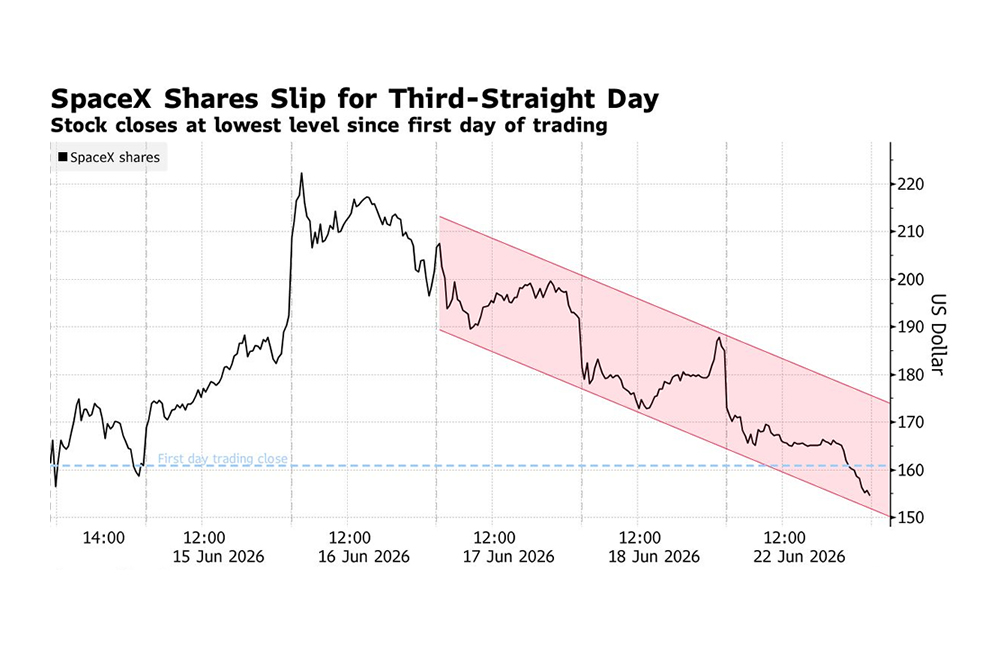
SpaceX, led by Elon Musk, has seen its stock price decline for three straight trading days, wiping out hundreds of billions of dollars in market value after the company announced its first-ever investment-grade bond offering. The move is part of a large-scale borrowing plan designed to fund the company’s ambitious artificial intelligence initiatives.
On Monday, SpaceX shares tumbled 16% to close at $154.60, hitting a record low since the company’s listing. The stock has slumped 23% over three consecutive sessions, resulting in a market value loss of more than $600 billion. The company’s market capitalization currently stands slightly above $2 trillion.
Following its record-breaking $75 billion IPO, SpaceX has experienced extreme price volatility, a common trait for newly listed stocks with low trading liquidity. Only 4.2% of its shares were available for trading on the debut day, creating highly concentrated ownership. Even so, the stock has attracted extraordinary retail investor interest. Despite Monday’s sharp pullback, SpaceX still trades roughly 15% above its IPO price of $135, retaining its position as the world’s sixth-largest company by market capitalization.
According to market reports, SpaceX aims to raise at least $20 billion through its inaugural bond issuance to support business expansion. Separately, the company confirmed a multibillion-dollar deal on Monday to provide computing resources for AI startup Reflection AI, further advancing its layout in the artificial intelligence sector.
SpaceX officially stepped into the AI industry in February this year after acquiring xAI, another artificial intelligence firm founded by Elon Musk. With SpaceX’s successful public listing, market attention has shifted toward the capitalization trends of leading global AI companies. Its major rivals, Anthropic PBC and OpenAI, are both targeting potential IPOs as early as this year, with each expected to reach a valuation of approximately $1 trillion, signaling an upcoming wave of AI public listings.
SpaceX’s listing has recorded one of the strongest retail investor participation levels among all IPOs in recent years. Data shows retail investors posted a net purchase of $405 million within the first five trading days after the listing. Last week, retail inflows into SpaceX exceeded the total retail buying volume of all stocks within the U.S. “Magnificent Seven” tech giants. Even amid Monday’s steep decline, retail investors remained net buyers of SpaceX shares, though trading enthusiasm moderated compared with the previous week.
[Disclaimer] Forex trading involves risk; please invest with caution. This content is for informational purposes and objective analysis only, and does not constitute any investment advice, basis for buying/selling, or guarantee of returns. Investors should make independent decisions based on their own financial situation and risk tolerance, and bear their own investment risks.
Related Posts

23/09/2026
23/09/2026