
The turmoil in the oil market may worsen as more Gulf oil giants cut production
On Monday, the unprecedented chaos triggered by the conflict with Iran set to further destabilize the oil market: major oil producers are cutting output while inventories continue to rise, and the world’s most vital waterway remains virtually closed.
The UAE and Kuwait have already begun production cuts due to running out of storage facilities, and Iraq has joined them, with its output now down by about 60%. As tankers continue to avoid the narrow Strait of Hormuz, the number of empty vessels available for loading is rapidly dwindling, and other countries may be forced to follow suit. Once all tankers are occupied, the region’s remaining onshore storage facilities will fill up even faster.
This turmoil has lasted nine days with no signs of abating, meaning that this waterway, which typically carries one-fifth of the world’s oil shipments, is now impassable. Saudi Arabia is diverting a record amount of crude oil to its Red Sea exports, which has at least helped alleviate some of the pressure.
In the face of the US and Israeli airstrikes that began on February 28, Iran has vowed not to back down. US President Donald Trump responded on Saturday, saying the US would now consider attacks on previously untargeted areas and populations within Iran. He posted on social media that the attacks would continue “until they surrender, or more likely, completely collapse!”
For oil analysts, executives, and traders, this means they are issuing repeated warnings that the war is pushing crude oil prices to a tipping point, nearing the psychological threshold of $100 a barrel. Brent crude rose 30% last week, its biggest gain in six years, and is just a few dollars away from that level.
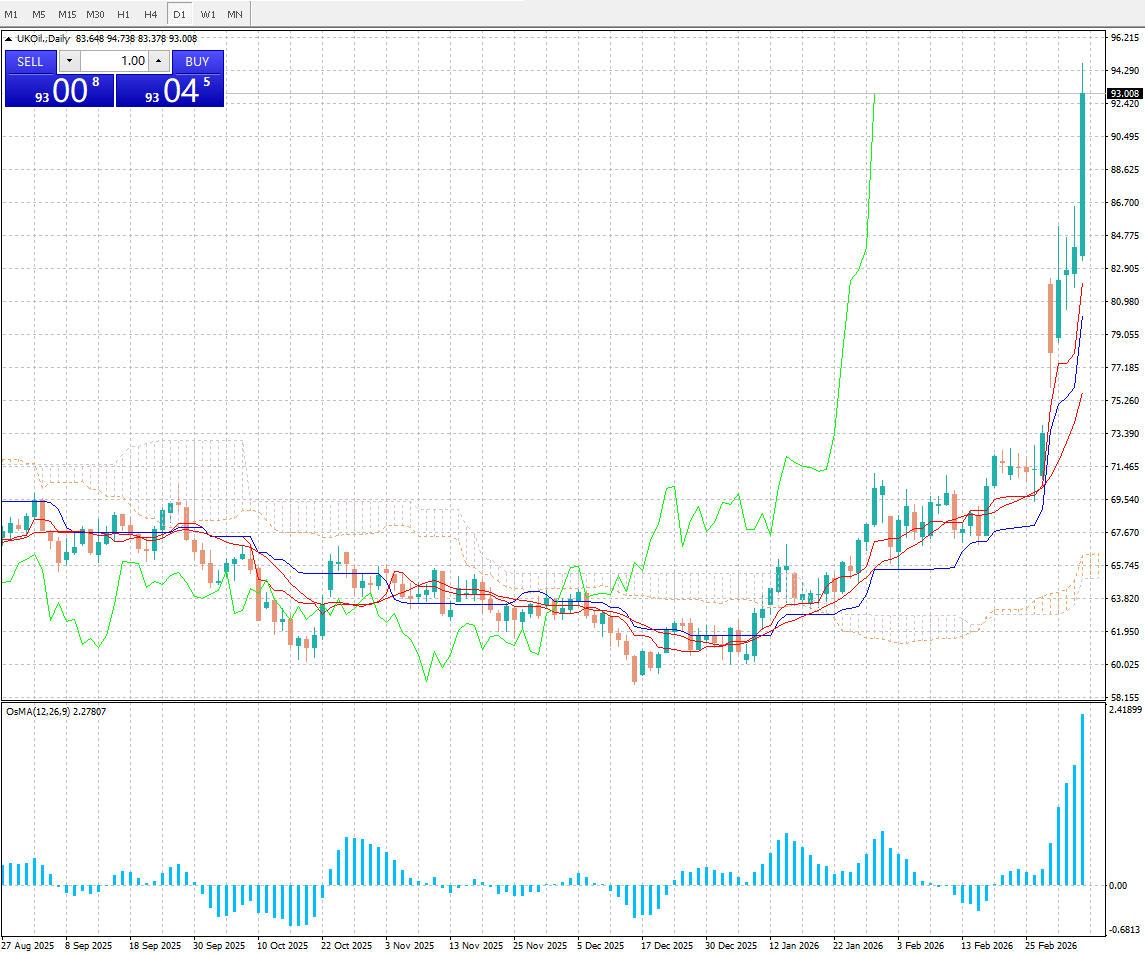
Crude oil futures prices, closely linked to the region, have already broken through this level. On Friday, Abu Dhabi’s flagship Murban crude futures closed at $103 a barrel, and Oman crude futures closed at $107 a barrel. Chinese crude futures on the Shanghai International Energy Exchange closed at $109 a barrel in dollar terms.
The escalating threat to oil infrastructure increases the risk of prolonged disruptions following an attack on the region. Saudi Arabia intercepted a drone heading towards the 1 million-barrel-per-day Sheba oil field over the weekend. Attacks in Bahrain and Qatar continue.
Furthermore, the Strait of Hormuz remains closed. In the past few days, only oil tankers linked to Iran and two bulk carriers claiming Chinese ownership have been spotted passing through the strait.
According to sources, the effective shutdown of oil extraction has caused Iraq’s daily oil production to drop to approximately 1.7 million to 1.8 million barrels, compared to approximately 4.3 million barrels per day before the conflict.
Meanwhile, Saudi Arabia is shipping crude oil to its Red Sea coast at an unprecedented rate. Ship tracking data compiled by Bloomberg shows that crude oil shipments from Saudi western terminals have surged to approximately 2.3 million barrels per day so far this month. While this is about 50% higher than Saudi Arabia’s monthly shipments from the Red Sea since the end of 2016, it is far below the country’s average of 6 million barrels per day exported from the Persian Gulf in recent months.
US Government Actions The US has pledged to strengthen financial protection and may provide military escort. On Friday, the US announced it would launch marine reinsurance for the Persian Gulf region. The statement said the mechanism would provide “rolling” coverage for losses of up to approximately $20 billion.
On Sunday, U.S. Energy Secretary Chris Wright said the panic premium currently reflected in the oil market would not last. Speaking on CNN’s State of the Union address, he said war would only temporarily disrupt markets and shipping, and even in the worst-case scenario, things would return to normal in just a few weeks, not months.
However, for shipowners and charterers operating in the region, insurance costs are not the primary obstacle to shipping. They are more concerned about the safety of their ships and crew, and have indicated a need for comprehensive naval escorts—similar to the “Operation Prosperity Guardians” coalition aimed at securing shipping in the Red Sea—or better yet, a cessation of hostilities.
Other measures taken by the U.S. to curb rising oil prices include allowing India to use oil currently stored in Russian floating storage facilities in the region. Washington has also considered using its strategic petroleum reserves and even intervening in the futures market—but officials have later downplayed these ideas, and Trump has dismissed inflation concerns, even as U.S. gasoline prices soar.
“This is just a short-term investment,” he said on Saturday. “We anticipated oil prices would rise (and they did), but they will also fall, and fall very quickly.”
Asia, heavily reliant on imports and closely tied to the Middle East, is bearing the most direct impact.
Japan, which sources over 90% of its crude oil from the region, is requesting the use of its national oil reserves. Other countries, including China, have restricted fuel exports to secure supplies and control domestic oil prices. Yonhap News Agency reported on Sunday, citing government officials, that South Korea is considering restoring an oil price ceiling for the first time in 30 years.
Meanwhile, according to data from the General Index since 2008, jet fuel prices in Northwest Europe surged to a record high of $1,528 per tonne on Thursday, equivalent to over $190 per barrel. The impact on jet fuel prices is particularly pronounced because half of the EU’s jet fuel imports typically pass through the Strait of Hormuz.
[Disclaimer] Forex trading involves risk; please invest with caution. This content is for informational purposes and objective analysis only, and does not constitute any investment advice, basis for buying/selling, or guarantee of returns. Investors should make independent decisions based on their own financial situation and risk tolerance, and bear their own investment risks.
before: FXCG Market Research Report: Week Ahead (March 8, 2026)